
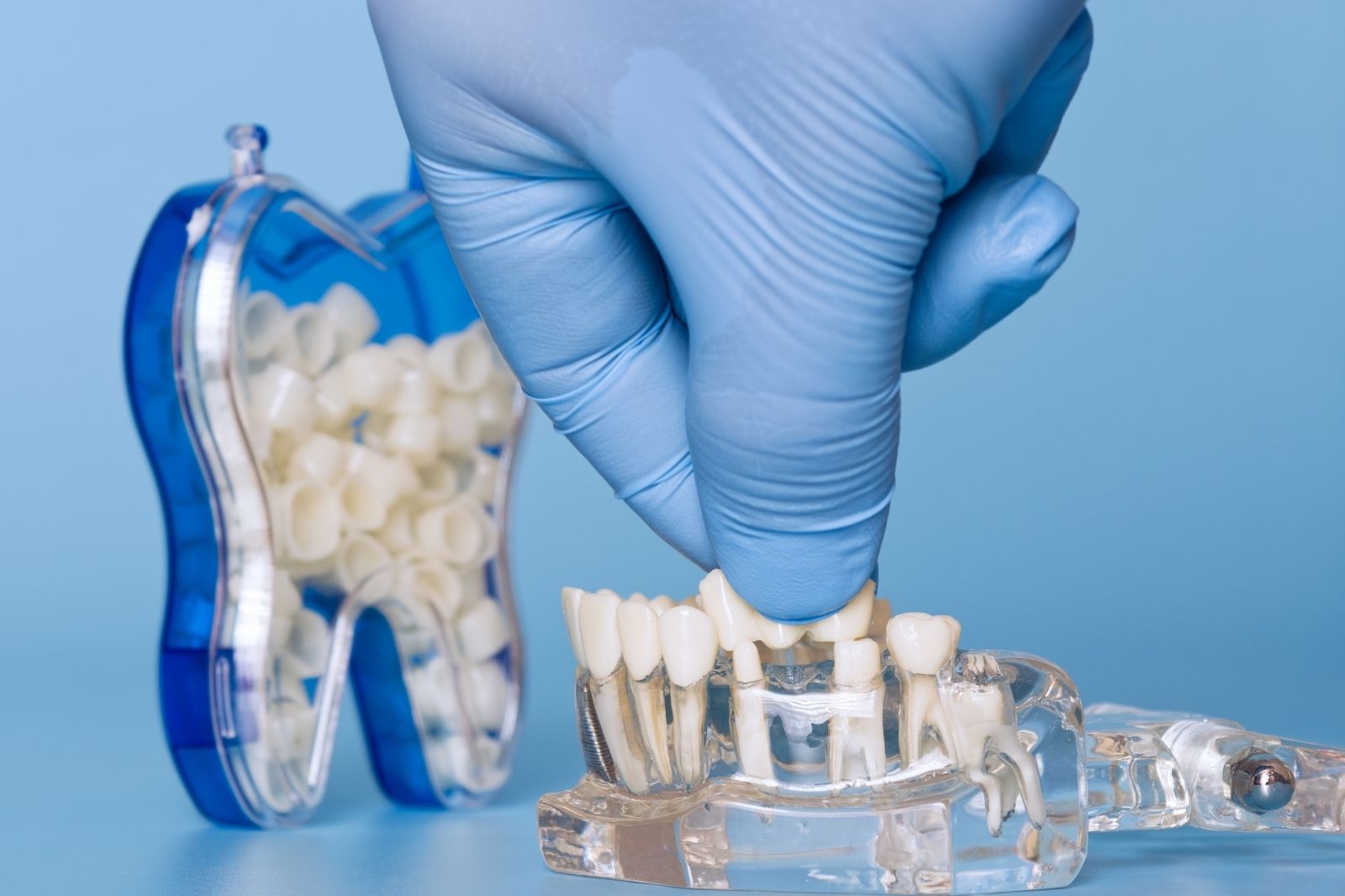
While often discussed together, crown and bridges serve unique functional roles. One can prefer dental crowns and bridges because they provide a permanent way to protect weakened teeth, prevent teeth from shifting out of place, and improve eating and speaking. The efficacy, however, depends upon the precision of the fit and the quality of the materials used.
This article will help you learn if you’d benefit from them. But first, let’s understand the basics of dental crown and bridges.
| Feature | Tooth Crown | Dental Bridge |
| Primary Indication | Designed to restore and reinforce a single compromised or structurally weakened tooth | Used to replace one or more missing teeth by spanning the gap |
| Fixation Method | Precisely bonded over the existing natural tooth to provide full coverage and protection | Securely supported by adjacent natural teeth or dental implants, forming a fixed prosthetic unit |
| Physical Sensation | Closely replicates the strength, contour, and function of a natural tooth | Offers a stable, fixed solution that feels more natural and secure than removable dentures |
| Key Health Benefit | Preserves the natural tooth structure and helps avoid extraction | Prevents neighbouring teeth from shifting, maintaining proper bite alignment and oral balance |
-
Is a cracked or weakened tooth causing you constant worry?
A tooth crown prevents further fractures and saves the natural tooth.
If you have a tooth that has been compromised by a large cavity, a crack, or a recent root canal, it no longer has the strength to handle the pressure of daily chewing. Without extra support, the tooth is likely to fracture further, which often leads to the need for a full extraction.
At Aelite Dental, we use a tooth crown to solve this problem by:
- Acting as a protective cover: The tooth crown fits over your existing tooth like a cap, shielding the vulnerable structure underneath.
- Preventing further damage: By holding the tooth together, we stop cracks from spreading toward the root.
- Restoring full function: You can bite down firmly again without the fear of the tooth breaking or causing pain.
By reinforcing a weak spot now, you can avoid more invasive and expensive procedures in the future.
-
Are missing teeth making it difficult for you to enjoy your favourite foods?
Custom-fitted crown and bridges can restore full chewing force.
When you lose a tooth, the simple act of eating can become a challenge. You might find yourself chewing only on one side of your mouth or avoiding certain foods altogether, which can impact your nutrition and digestion.
Process here involves:
- Filling the void: A bridge spans the space left by a missing tooth, giving you a solid surface to chew on.
- Balancing your bite: The pressure is spread evenly across your mouth, preventing strain on your other teeth.
- Clearer speech: Teeth play a vital role in how you form sounds; filling gaps helps you speak more clearly and naturally.
Simply, dental crown and bridges restore your chewing surfaces so you can eat normally again.
-
Could a gap in your smile be leading to crooked teeth or jaw pain?
Dental crowns and bridges act as structural spacers that lock healthy teeth in place.
Your teeth rely on each other to stay in the correct position. When a gap is left, the teeth on either side will slowly start to tilt or drift into it. This movement can ruin your alignment and lead to issues with your jaw joint.
At Aelite Dental, we recommend dental crowns and bridges to maintain the structure of your smile where:
- A bridge acts as a sturdy spacer, preventing your healthy teeth from moving.
- Proper alignment prevents your jaw joint from being overworked by an uneven bite.
When your teeth stay in their right spots, they do not rub together in ways that cause premature enamel wear.
-
Is the appearance of your teeth holding you back in social or professional settings?
They are indistinguishable from natural teeth.
It is difficult to feel like yourself when you are self-conscious about a missing or badly damaged tooth. Modern dental crowns and bridges are designed to be completely indistinguishable from the teeth you were born with.
At Aelite Dental, we believe that everyone deserves a smile they are proud to show off with:
- Natural colour matching: The shade of your tooth crown or bridge to your surrounding teeth so the result looks seamless.
- Realistic materials: Advanced ceramics that reflect light just like natural enamel, avoiding the flat or grey look of older dental work.
Additionally, beyond just fixing damage, tooth crowns improve the shape of a tooth that has always looked out of place.
-
Are you tired of short-term dental fixes that keep failing?
They offer a definitive, long-term solution with superior durability.
While a large filling might seem like an easy fix, it often cannot withstand the heavy load your back teeth require. Over time, these fillings can leak or fall out, causing more damage to the tooth each time they are replaced.
Dental crowns and bridges are a long-term, reliable solution because:
- Decades of durability: With good home care and regular check-ups at Aelite Dental, these restorations can last fifteen years or longer.
- High-strength materials: Materials like zirconia that are incredibly tough and resistant to chipping.
In conclusion, because they do not need to be replaced as often as fillings, dental crowns and bridges are a smarter investment for your future.
However, the most important aspect to understand is that a professional consultation is the safest way to determine which restoration is suitable for you. If you think you need either dental crowns and bridges, Aelite Dental can help you.
Book your appointment if you are searching for dental crowns and bridges Hurstville or dental crowns and bridges Bexley.
FAQs
Q. What is the fundamental difference between a dental crown and a bridge?
A crown is a custom-made cap placed over a single damaged tooth to restore its shape and strength. A bridge is a prosthetic used to replace one or more missing teeth by anchoring to the natural teeth or implants on either side of a gap.
Q. Is the procedure for getting a crown or bridge painful?
Modern local anaesthetics ensure the area is completely numb during the preparation phase. Most patients experience minor sensitivity or tenderness in the gums for a few days following the appointment, which is easily managed with standard over-the-counter pain relief.
Q. How many dental appointments are required for a bridge?
Typically, two appointments are necessary. The first involves preparing the anchor teeth and taking a digital or physical impression. The second appointment involves fitting and bonding the final prosthetic once it has been fabricated in a laboratory.
Q. Can a tooth still develop decay under a dental crown?
Yes. While the crown itself cannot decay, the natural tooth structure underneath and at the gum line is still susceptible to bacteria. Careful brushing and flossing are essential to prevent plaque from accumulating at the margin where the crown meets the tooth.
Q. Is a dental bridge better than a dental implant?
Neither is objectively better; the choice depends on clinical needs. Bridges are faster to complete and do not require surgery. However, implants do not require the alteration of healthy adjacent teeth and help preserve the jawbone more effectively over time.
Q. Can a dental crown be whitened if it becomes stained?
No. Dental ceramics and porcelains are resistant to bleaching agents. If a crown becomes discoloured or no longer matches the surrounding teeth after a whitening treatment, the only way to change its colour is to replace the restoration entirely.
Q. What happens if a dental crown falls off?
If a crown comes loose, it is important to keep the crown and contact a dentist immediately. Do not attempt to glue it back on with household adhesives. In many cases, if the underlying tooth is still healthy, the crown can be professionally cleaned and recemented.
Q. How to clean crowns and bridges
Use floss threaders, Super Floss, or interdental brushes to clean under bridges.